Pages

Tuesday, June 11, 2013

Shelley Gregory's Post: Were You There:

As my practice develops I am becoming more interested in the power of art to engage with communities. Art may not be able to solve issues per say but it can raise awareness and facilitate questions.
As we explored the park over the week we used various techniques, geomapping, sound walks, drawing, photography and group discussions. The overwhelming sound within the park for me was the birdsong. The park is a haven for a variety of birds including a woodpecker.
On one of my sound recording walks I stood beneath a tree capturing the sound of a blackbird. The rain was falling from a very grey sky but his song was still joyous. For those few moments nothing else mattered I was completely focused on the song. It was then that a couple walked by. They were soaking wet, weary and from their conversation as they passed by in pain from a long walk.  As I suspected they were homeless. It was this moment that sparked the idea for my piece. Hanley Park is so important to them, it is where they are living at the moment. They find shelter there. I was reminded of the old hymn, “When I Needed a Shelter, Were You There?”
There is a pagoda in the park, a relic from the 1986 Garden Festival. It is small but it is a shelter. I printed the words to the song and hung them in the roof. I wanted a visual reference to each verse so beneath the words I placed cardboard boxes to be plinths for objects, a reminder of the Cardboard City.
“I was cold I was naked” – A blanket, “I was hungry and thirsty” – Bread, fruit and grape juice, “I needed a shelter” – a house brick, “I needed a neighbour” – a cup of sugar. Not only are they practical symbols of our basic needs as human beings they reflect the answer that I have found in my life to meet my needs. As a Christian I read the Bible and see that the life of Jesus is reflected in these objects. He drank from the cup of suffering and was crucified, His folded grave clothes were a sign of His resurrection, Communion reminds me of this and I have found a permanent home with Him. These spiritual beliefs call me to live a life that provides practical help.
Everyone I spoke to that was using the park on Saturday would like it to have a café. I think that if the HFL bid is successful then a café should be priority. It would be a good hub within the park for everyone.  I know that some coffee shops have a system where customers can buy a ‘spare drink’ with their own. Then if a homeless person comes in they can get a drink. It’s a small thing but it can make a huge difference.
The residency was an amazing experience and I wouldn’t hesitate to apply for similar projects in the future.  

Monday, June 10, 2013

Carrie Pletscher, Contemporary Art Practice FdA student


Despite the rainy start to the week, the group were warm, welcoming and eager to engage in the process of response to site.

My background in Garden Design has conditioned me to formulate a pragmatic response to a site - through technical surveys of dimensions, orientation and site features - so exploring alternative ways of recording the site, such as audio walks and GPS tracking, gave me a fresh approach, a wider palette of possibilities and encouraged varied responses from participants.

One of the aims of the residency was to use our interventions to gather opinions from park users, which would feed into the Heritage Lottery Fund development bid, so I was keen to base my response on the park users themselves, and how they use the site, rather than the wealth of historic features and mature planting schemes.

One of my first observations within the park was the enormous but unrealised potential for viewpoints due to the sloping nature of the site which had been developed into terraces. Our inherent desire to seek out vantage points was thwarted by the overgrown planting.


Environmental Psychology is the study of how surroundings influence people; how they feel, how they move about and how they interact. The former ‘Oval Bowling Green’ is no longer maintained as a bowling green but I was interested to observe that the majority of visitors followed the perimeter paths rather than creating ‘desire lines’ by cutting across the grass. This prompted me to think about the nature of this open space and to explore ideas for encouraging visitors to venture onto it; to challenge the historic ‘KEEP OFF THE GRASS’ status that bowling greens evoke.


I wanted to encourage visitors to walk about within the space, rather than to simply walk through it, so decided to use an ancient device for creating a symbolic journey within a confined area; a labyrinth. Labyrinths have featured in most cultures throughout history and have many uses ranging from spiritual contemplation to exercise and fun. They differ from mazes in that there is a single route leading to the centre and back out again. Additionally the decorative geometric pattern of the labyrinth could be viewed from the approach bridge and from other positions along the bandstand terrace - if the overgrown planting were cut back to create the potential viewpoints that I had earlier identified.

During group discussions I discovered that another student had developed a similar response to the former Oval Bowling Green so we decided to work together to create our temporary intervention. 

I envisioned a labyrinth of mown grass paths with a picnic glade at the centre, bordered by tall grasses and wildflowers which would increase biodiversity and insect habitat through a sustainable, low-maintenance and vandal-proof planting scheme.
(image by Jan Glennie-Smith, Available from: 

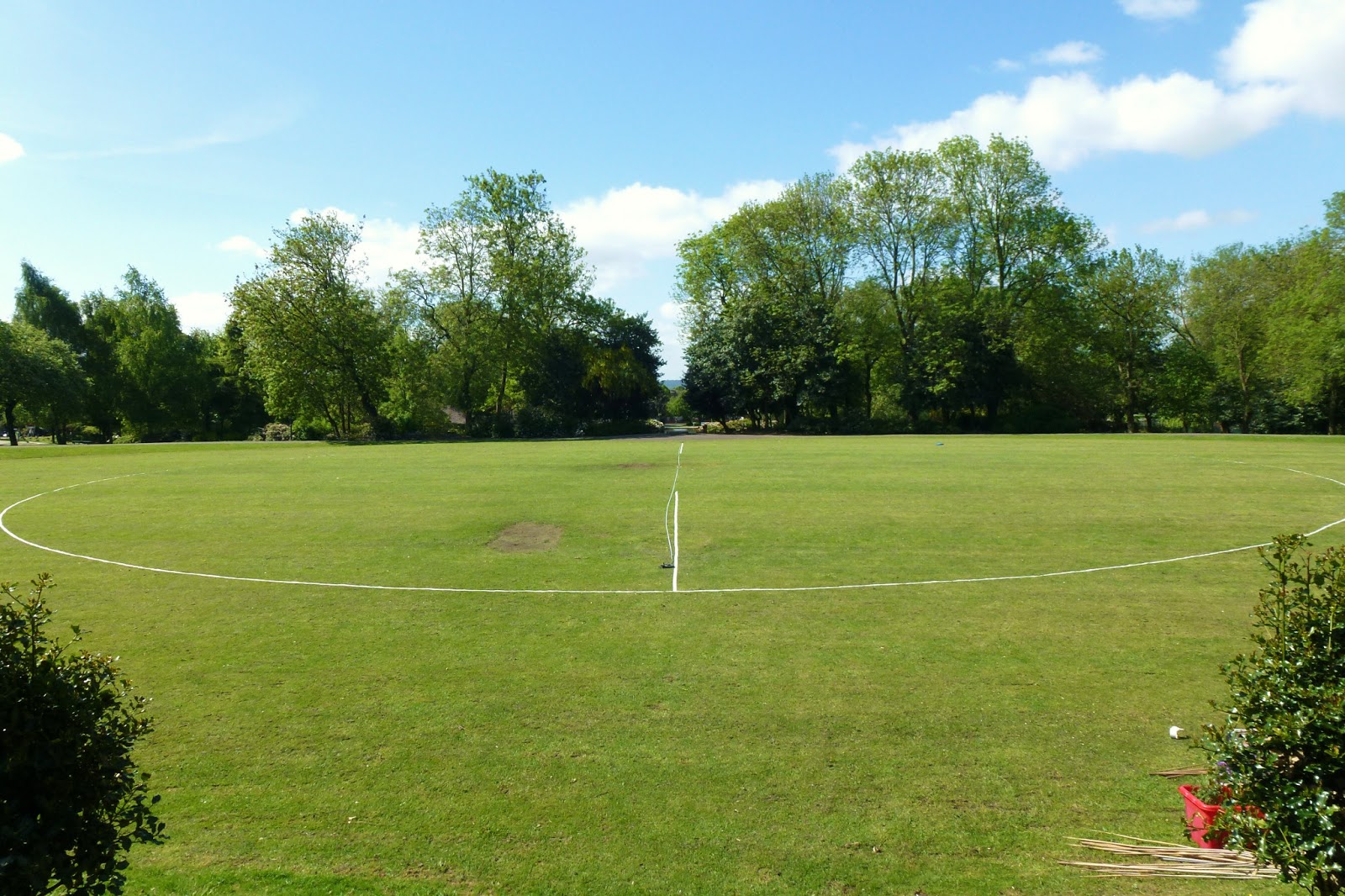
Given the short timescale and temporary nature of our interventions we decided to create the labyrinth using masking tape. Our 40m diameter design took two and a half hours to lay out and used over 700m of tape.


It was fascinating to observe how simple white lines compelled visitors to follow them, tracing the concentric circles, inspiring impromptu races and creating a sense of achievement for having completed the route. The space was reclaimed and reincarnated - if only for the afternoon – but I would be delighted to see the idea taken forward in the future development of the park.


Wednesday, June 5, 2013

The Park Traces Residency

The Park Traces Student Residency concluded just over a week ago, and it is about time I got around to writing up what happened.
9 students worked with 4 artists, myself, Bethan Lloyd Worthington, Phil Rawle and Andrew Branscombe (who was with us on day one for a GPS session, and the final day to help with install and technical stuff) plus Glen Stoker did a great job of photographic documentation.
We started on Tuesday 28th may, with a series of workshops on Day one and two, designed to help everyone get to know each other at the gallery, and then orient the group around the park.
This included drawing sessions, photowalks, spoken word walks, a reading session led by Bethan, which included texts on Park Design, fiction and architectural texts and various other activities to look at the place, and set the context. We talked about what the role of the Heritage Lottery project might be, and how the park may change. Pauline Withington from the council parks team came along, and gave us a great insight into the processes of change, and was really generous with her time - especially as it was raining!
We also during the week did a session on talking to the public, designing a creative consultation tool to use alongside the developed artworks, hopefully using the works created as a way in to talking to the public about the future of the park.
The 9 students had support from the artists to develop their ideas, and had to very quickly come up with plans to intervene.
The Saturday saw us meeting up bright and early in the park to install the works, and get ready for the day ahead. The sun was out, and everyone was armed with the consultation tools to start conversations with the public.
The Projects:
The above map shows the locations of the 11 artworks produced, and the page below the details given out to the public, to help them locate and find out about the works.
Details of a few of the works: Dan Hayes created a 'Beacon of Hope' which was a sculptural piece, photographed in various locations around the park, bringing light and hope to otherwise forgotten areas.
The sculptural piece was exhibited on the day, unplugged, alongside images of the lit up beacons, talking about the current wasted potential in the park,
but looking to a future where light is brought back into this wonderful space.
Next, we saw Phil Rawle picking up on the various staircases in the park, which make it more difficult, for wheelchair users and parents with buggies.
Phil drew out a technical drawing of a staircase on the ground in chalk, also referencing the stages of development needed to see the park back to its former glory.
Charlotte Howell, was interested in drawing attention to some of the really beautiful features that can be easily overlooked in the park, and created a Heritage Treasure trail.
This piece did a fantastic job of getting the public exploring the park differently, and was particularly popular with the younger park users, and their families.
Sophie Henshaw created a fairy garden from a particularly wild part of the Park. 
A proposition for a wild flower patch on the left, and a flower potting activity were designed to keep younger park users entertained, and as a way of starting a conversation about the importance of green spaces.
The piece that I worked on involved the use of a motif that I have been developing lately, Buddleia.
The plant is able to find even the smallest piece of fertile ground and bloom there, and I am using it as a metaphor for the way that artists maximise all potential, in the most unlikely places, and make creative statements. One of the things that my practice tends to pick up on, is gaps.
One of the glaring gaps for me, in the park as it is today, is in the amenities and facilities for park users.
Toilets in particular are an issue, as the toilets are often closed, and when open, they are in a pretty bad state. I decided that 'every bog should have its day' and decided to clean up the ladies, and make them pleasant for the day of Park Traces.
This intervention would be flagged by the Buddleia on the ladies toilet sign, which we also cleaned and painted up.
Bethan Lloyd Worthington became interested in the bowling pavilion block (now unused apart from the toilets) as this was one of the buildings that Pauline mentioned they may wish to get rid of. This sparked lots of conversation around the value placed on heritage buildings, if it is more than 100 years old it must be kept, but anything since the 50s needs to be knocked down. Will this be something we will live to regret?
Each of the participating artists have been invited to write up their experiences, so see other posts for details.

Monday, June 3, 2013

Bethan Lloyd Worthington - Visiting Artist

On the first afternoon, in pouring rain, we took a walk around the park. We took in the derelict buildings and appreciated the lake. When we got to the 1960s Bowls Pavilion (now merely an unreliable public toilet), one amongst the group said "It's just not good architecture, is it?" I was surprised by how strongly I disagreed, and I knew I had my title.


It seems possible this building won't survive the English Heritage Lottery funding. It isn't part of the original scheme for the park and it's a much-maligned era in British architecture, but one which has long, long been in the ascendant - the Manchester Modernist Society, the National Trust owned 2 Willow Road and 'Mid-Century Modern' everything being obvious points of reference for fashionable concrete-love. For me the pavilion just inspires fondness. It's a thoughtful building with a verandah and good light. Swooping curves and aspirational angles to eat ice-cream under. No escaping, however, a scent that a perfumer might refer to as feline... or animalic.


The work I made was partly an attempt to beg another view of this building, perhaps to suggest links with more glamorous architectural cousins around the world, the ones with the swimming pools and the preservation orders. I made a faithful drawing with a more optimistic atmosphere and photographs of the light on the pastel tiles.


I also 'restored' the skeletal screen on the verandah, replacing missing lines with masking tape, and placed a 1960s dressing table mirror on the ground, looking up at the sky.


Alongside making my own response, I led a drawing session for students in the park and a reading session at AirSpace, where we discussed a variety of texts on subjects relating to the project - from Ian Sinclair on his local park in Upper Clapton, to Tash Aw's portrait of a petulant British Malay ex-pat dreaming up a garden painted with flowers just so. I was really interested in what the students had to say and the resulting interventions. I look forward to following the Hanley Park's development and cross my fingers for the pavilion.

Tuesday, May 28, 2013

Geotagging and Logging

Day one of Park Traces saw an introduction into various ways in which a space can be explored. Part of this was to look at the possibilities of geolocating yourself within the space.

Photo-Geotagging

This process utilises GPS technology, which can be embedded within image files in order to locate these images on mapping platforms such as google maps and google earth. The technology gives an alternative way of documenting or using images in relation to space, location and time.


This map presents some documentary images of the day, these images were taken using a smartphone with GPS to locate the images.

Logging

This is the second use of GPS technology that automatically records your position every few seconds, and enables you to track the route that you take between points.


View Audio Walk logger trace in a larger map

The map shows the route taken during a spoken word walk through the park.

Tagging and Logging

This map shows the use of both techniques. Tagging; positions the photographs on the map, while logging records the route taken in order to capture those images.


Monday, April 15, 2013

Call Out Now for Art Students to take part in Site Responsive Residency in the Park


Call is out now for current students to take part in this fantastic opportunity: Here is the call:
Site Responsive Land Art for the 21st Century - A residency opportunity for students.
May 27th - June 1st 2013
Site Responsive Land Art for the 21st Century is a one week project, which forms part of the University’s involvement in a year long partnership project called ‘Park Traces’ between the University, AirSpace gallery, and Stoke-on-Trent council, to creatively document Hanley Park, and create a lasting record of the park as it is today.
The project provides an opportunity for students to take part in a site responsive research project, with real outcomes. You will work with 3 artists to generate artworks in response to this Inner City Victorian Park, the works produced will feed into the Heritage Lottery Funded research and development project, which is working towards bidding for a £4.9m HLF grant. (A bid development grant of £420,000 has already been secured.)
‘Park Traces: Site Responsive Land Art for the 21st Century’ project is part of a larger 12 month intervention and documentation project, which aims to document a year in the life of an inner-city public park.
You will work as co-producers on the residency, and will use photography, drawing, geomapping techniques, sound and text to gather information and formulate a response. You will then use and extend your own practice and skills to build an intervention in the park, which will aim to draw attention to the park's features, and suggest solutions for the future. We will also discuss the role of artists in social contexts, and will talk about creative consultation in relation to the artworks produced. The artworks that you produce will be exhibited in an open air exhibition during FRINGE as a way to instigate conversation with park users about the future developments of the park.
This is a fantastic opportunity for you to gain invaluable experience for your CV, in exhibiting as well as working on a public realm project.
The project will be documented and shown on a project blog, and results will also be used in a publication.
You need to be able to commit to working from 10 - 5 each day on the following days in order to eligible to take up this opportunity. 
May 27th: Walks and talks in the park, first explorations and stakeholder meetings.
May 28th: Photographic  Geomapping and GPS Data building, and basic consultation techniques.
May 29th: Drawing response.
May 30th: Proposal for intervention
May 31st: Finalising responses and fabrication ahead of Exhibition
June 1st: Public Exhibition 
£25 per student will be made available to spend in the art shop on materials for your response.

To apply for a place on the Residency please email: a 250 word statement detailing why you are right for this opportunity, and how you would approach it to a.m.francis@staffs.ac.uk by Monday, May 6th 2013.


Friday, April 5, 2013

Spring Walk One

It was the practical beginning of the Park Traces project, as I did my first walk today. To really get to grips with the context and methods to be used I am kicking off with a series of Spring Walks, the first of these are solitary, but later I intend to invite other people to walk with me. These walks will be photo walks, text walks, sound walks and other walks.
I have never done a dedicated sound walk before, although I have recorded audio on a walk before, I have never set out for the walk to be a sound walk, so thought it would be a good way to start, as I think it would be true to say that often the other senses take over.
It was very interesting to walk the park this way. My hearing became ultra sensitised, as I walked, thinking about what I was hearing and how it might come out on the audio. I found myself wanting to walk slightly differently to the usual route I might take through the park, considering the sounds I might come across, and on occasion, rerouting in order to include a sound. The route taken looks like an upside down bird of prey in the end, well at least the head and shoulders of one. Sounds I heard on the walk include:
Spring should be here, and I did see signs that it is on the way. The sun was out, though not warm, but there were still patches of snow in places. Considering it is still school holidays the park was relatively empty.